
Overview
AgentLoop is a local-first automation tool that lets you plan a coding goal once in ChatGPT, then runs that goal through fresh Codex workers and independent critics until your quality standards are met. It handles the entire handoff loop—planner to worker, worker to critic, then critic feedback into the next cycle—so you don’t have to manually relay messages between planning and code. The system runs on your local machine (requires Node.js 18+, Git, and an authenticated Codex CLI) without any hosted workspace or npm install. It’s designed for developers who want to set a bounded goal and acceptance criteria, then let the loop iterate until the work passes.
Application scenarios
Feature development
Ship a complete feature like adding CSV export across the UI, API, and regression suite.
Code migration
Run a migration pass with fresh workers and independent critics to verify correctness.
Hardening
Apply a hardening pass to improve code security or robustness, with critic checks for edge cases.
Product polish
Use the loop for polish tasks where you need a bounded goal and clear acceptance criteria.
Bug fixing
Give it a defect report, and the loop will generate fixes, then have a critic verify the result independently.
Regression testing
Add regression coverage automatically—the critic catches what green tests miss, like a mixed percent-decoding defect.
Core features
Plan-once workflow
Define the finish line in ChatGPT, then send AgentLoop a bounded goal with your rubric stored in GUIDELINES.md.
Fresh workers every cycle
Each cycle starts with a clean Codex worker that reads the goal, edits local files, runs tools, and leaves evidence behind.
Independent critic
A separate fresh process reviews every result, catching defects that passing tests might miss (e.g., a mixed percent-decoding bug even when 9/9 tests pass).
Files as memory
Project files carry the evidence forward across cycles—no external database or hosted storage.
Cycle log and observability
Watch every cycle, verdict, transcript, cost, and file handoff from a dashboard. You can cancel from the dashboard or ask ChatGPT for status through MCP.
Local-first execution
Runs on your local machine (Windows, macOS, Linux) with no hosted workspace. Requires Node.js 18+, Git, and an authenticated Codex CLI.
Rubric-driven completion
Your GUIDELINES.md defines the acceptance criteria, and the loop repeats until the critic passes your standards.
Live replay and demo
You can inspect the evaluation, watch an interactive replay, or view a 3-minute demo to see how the loop works.
Target users
This tool is built for developers and engineering teams who want to automate repetitive coding workflows—like feature additions, migrations, hardening passes, or polish—without manually babysitting each step. It’s ideal for anyone comfortable with Node.js, Git, and Codex CLI who wants to set a goal once and let an automated loop iterate until quality standards are met. Technical leads and senior engineers who need to offload handoff overhead while maintaining control will find it particularly useful.
How to use
Clone the repository: Run git clone --branch v1.1.0 --depth 1 https://github.com/aiedwardyi/AgentLoop.git then cd AgentLoop . Start the daemon: Execute node src\daemon.js (no npm install needed). Set your goal: Plan in ChatGPT, then send AgentLoop a bounded goal with your rubric in GUIDELINES.md. Monitor the loop: Watch cycles, verdicts, and file handoffs from the dashboard. Cancel or ask ChatGPT for status through MCP as needed. Review the output: The loop stops when the critic passes your rubric, leaving concrete fixes written to your local project files.
Effect review
AgentLoop delivers on its promise of automating the handoff between planning and code execution. The independent critic is a standout feature—it caught a real defect that nine passing tests missed, proving that green tests alone aren’t enough. The local-first approach (no hosted workspace, no npm install) keeps setup trivial and data private. For developers tired of manually relaying messages between planning sessions and code edits, this loop provides a clean, observable workflow. The live replay and dashboard give you full visibility into every cycle, cost, and file change, so you can run it unattended without losing the plot. It’s a practical tool for teams that want to ship features, migrations, or hardening passes with less manual overhead.
Frequently asked questions
What is AgentLoop?
AgentLoop is an AI tool that automates coding workflows: you plan once in ChatGPT, then it runs fresh Codex workers and independent critics until your quality standards are met.
How does AgentLoop ensure code quality?
AgentLoop uses independent critics that evaluate the output of Codex workers, iterating until predefined quality standards are satisfied.
Do I need to manually intervene during the process?
No, AgentLoop automates the entire workflow after you provide the initial plan in ChatGPT, requiring minimal manual intervention.
What programming languages does AgentLoop support?
AgentLoop supports any language that OpenAI Codex can generate, including Python, JavaScript, TypeScript, and more.
Is AgentLoop free to use?
Pricing details are not specified; you should check the official AgentLoop website for current pricing tiers and free trial availability.
Can I integrate AgentLoop with my existing development tools?
AgentLoop is designed to work with ChatGPT for planning and likely outputs code that can be integrated with standard development environments.
Launch URL
https://agentloop.tools/Tags
Featured recommendations

AgentGrid
alternativeAgentGrid by AgentGrid provides a unified infinite canvas for managing multiple AI agents, including Claude Code, Codex, and OpenCode, alongside terminals, browsers, and notes for streamlined multi-ag

Deep Work Plan
alternativeDeep Work Plan is a tool by its developers that transforms any repository into a structured environment, enabling coding agents to complete long-horizon tasks efficiently with context-driven focus.

OpenBot
alternativeOpenBot by GetOpenBot lets you coordinate specialized AI agents in a shared, local-first, open-source workspace. Browse the agent registry, bring your own keys, and orchestrate complex workflows effic
agentfdr
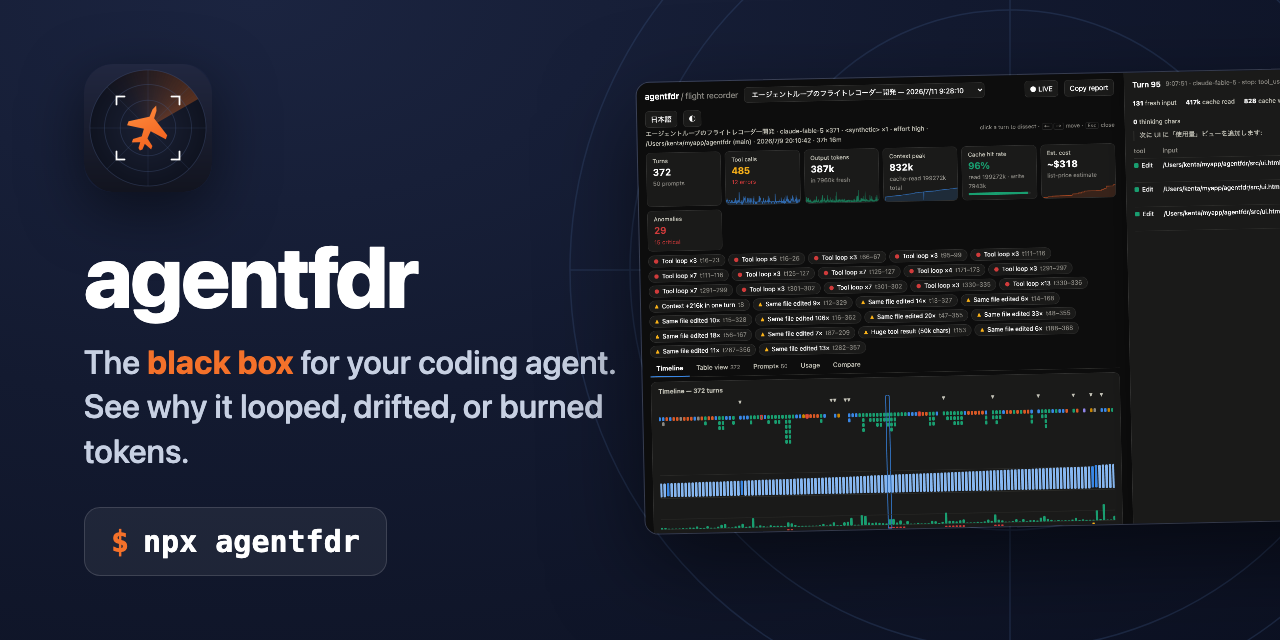
alternativeagentfdr by kamihork is a debugging tool for AI agents, revealing turn-by-turn execution logs after the fact. It identifies loops, goal drift, and token waste with zero instrumentation, operating loca

Pi Coding Agent
alternativeA terminal-based coding agent by Pi.dev for efficient command-line development, code generation, and debugging.

AI-Mate
alternativeAI-Mate by LenseTek transforms natural language ideas into production-ready AI agent systems. Decompose goals, generate sub-agents, orchestrate workflows, and export prompts for Codex, Claude, and oth

Conductor
alternativeConductor by Conductor creates parallel Codex and Claude Code agents in isolated workspaces, enabling users to monitor their progress and review or merge changes efficiently.

OpenCode
alternativeOpenCode by OpenCode.ai is an AI-powered development platform for generating, reviewing, and debugging code, enabling faster software creation and collaboration.
Related Toolkits
 AI Assistant / Agents
Caffeine
Caffeine by Caffeine AI enables you to build apps and websites via chat on an open tech stack specialized for AI, removing traditional limits and accelerating development.
View Details AI Assistant / Agents
Chuangyi AI
An AI multi-agent collaborative creation platform that provides AI employee outsourcing services for short film and short drama creators, unleashing content production efficiency!
View Details AI Assistant / Agents
Dify
Dify by LangGenius enables teams to develop, deploy, and manage autonomous agents, RAG pipelines, and agentic workflows at any scale effortlessly.
View Details